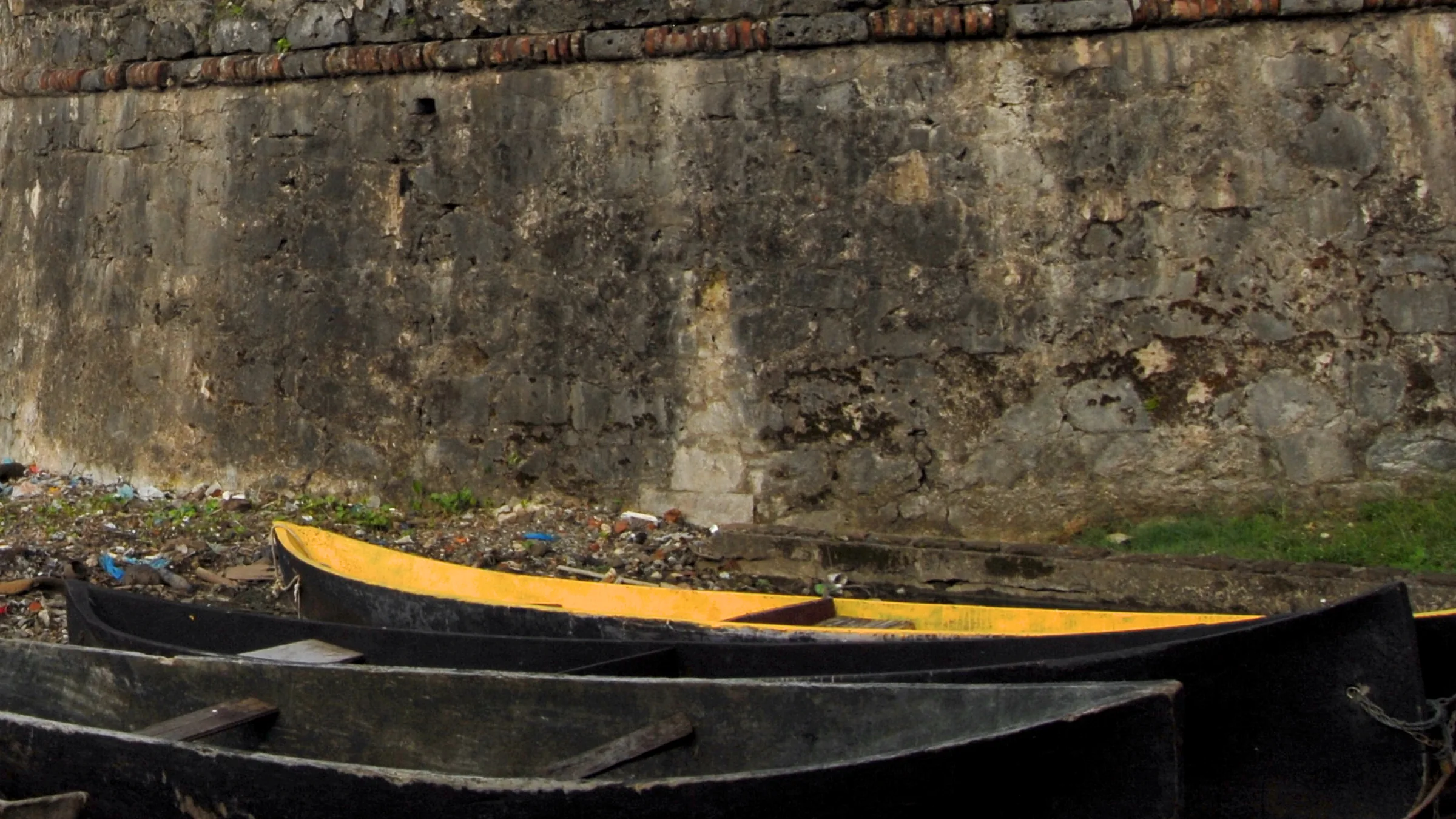
Stone wall of the fort at Portobelo with boats beached in front of it.

Panama · Colón (Caribbean)

Portobelo
and Colón's Costa Arriba.

Colonial forts, Congo culture and Caribbean islands about two hours from Panama City.

Photo: TEDBARTH · CC BY-SA 3.0

Before you go,
understand the place.

Portobelo was founded in 1597 and during the colonial period was one of the great ports of Spanish trade, with fairs and a royal customs house. Forts and batteries were built around the bay to defend it: Santiago de la Gloria, San Jerónimo and San Fernando. Together with Fort San Lorenzo, at the mouth of the Chagres River, they form a World Heritage property inscribed in 1980. In 2012 UNESCO placed it on the List of World Heritage in Danger because of environmental factors, lack of maintenance and urban development, and it remains there in 2026. In 2025 the forts also became part of the Colonial Transisthmian Route, inscribed as World Heritage.

Best time to go
According to IMHPA, it rains almost all year in the Atlantic region: from December to February northern-hemisphere fronts bring heavy rain there, just when the rest of the country is in its dry season (December–April). Visit Panamá describes December to March as the sunniest, breeziest months on Portobelo's beaches, and the rest of the year as rainy with sunny spells. For diving and snorkelling it recommends August and September, when the sea is usually calmer. In the dry season the trade winds can raise swells: IMHPA issued a watch in December 2025 with 1.2–2.6 m waves in Colón. In November 2025 heavy rain flooded parts of Portobelo. IMHPA puts the national rainy season from May to November and Canada from April to December; the Atlantic hurricane season runs from June to November. For culture, the Congo season runs from 20 January to Ash Wednesday and the Black Christ festival is on 21 October.
Getting there
By car: from Panama City take the Panamá–Colón highway to Sabanitas, then the signposted right turn to Portobelo. Visit Panamá gives about 1.5 hours on one page and about 2 hours on another; a third page gives one hour to Sabanitas and about 50 minutes from Sabanitas to Portobelo. The highway has a toll: Visit Panamá says it is paid in cash, and the Ministry of Public Works collects it at km 31 towards Colón (September 2025); the current amount is not confirmed by the official source at the time of review. Beyond Portobelo the road continues to La Guaira (pier for Isla Grande, about 2.5 hours from the capital) and Puerto Lindo (for Isla Mamey, about 2 hours). By bus: from the Albrook Grand Terminal there are buses to the Colón terminal or to Sabanitas, then a local bus or taxi to Portobelo; Visit Panamá estimates 2.5–3 hours in total. Albrook–Sabanitas costs about US$4 and takes about 90 minutes. For San Lorenzo: highway to Colón, cross the Canal at the Agua Clara locks and the Atlantic Bridge, then the road through former Fort Sherman; about 75 km (1 h 15 min) to Agua Clara and 15 km more to the fort, per Seis Grados magazine (April 2026). From Portobelo to San Lorenzo, drive back through Sabanitas and on towards Colón.

Five ways to explore

Themed guides

Places grouped by theme, to plan your day.

  • 7 places

    Forts and colonial heritage

    The Portobelo and San Lorenzo fortifications have been World Heritage since 1980 and remain on the Danger List. Several forts and the church are under restoration, and some parts are closed.

    Open the full guide
  • 5 places

    Congo culture and festivals

    Portobelo is a centre of Congo culture, inscribed by UNESCO in 2018, and of devotion to the Black Christ. Dates change each year: check them before you go.

    Open the full guide
  • 5 places

    Costa Arriba islands and beaches

    The best beaches are reached by boat from Portobelo, La Guaira or Puerto Lindo. Bring cash: the islands have almost no ATMs or card payments.

    Open the full guide
  • 5 places

    Diving and snorkelling

    Portobelo National Park's reefs are minutes away by boat. The site is chosen on the day depending on sea conditions.

    Open the full guide
  • 4 places

    Rainforest, trails and viewpoints

    Two protected areas frame the route: Portobelo National Park to the east and the San Lorenzo area west of the Canal. For long trails, go with a local guide.

    Open the full guide

The place, in context

Everything you can do

Closed or restricted places are included and flagged, so you know what to expect.

Showing 19 of 19 · 3 closed or restricted, flagged · 1 unconfirmed, flagged

Nature and jungle · 3

Sea, beach and reef · 4

Lakes, rivers and waterfalls · 2

Living culture · 10

Portobelo and Colón's Costa Arriba · Practical guide

The essentials

  1. Walking Santiago de la Gloria Castle and crossing by boat to Fort San Fernando.
  2. Learning Portobelo's African history at the free Afro-Panamanian Memory Museum.
  3. Seeing the Black Christ in San Felipe Church or joining its 21 October festival.
  4. Congo art and music at Casa Congo and, in season, diablos and congos in the streets.
  5. Snorkelling at La Huerta Beach and diving at Drake Island.
  6. A day on Isla Grande or Isla Mamey, or Fort San Lorenzo above the Chagres River.

Portobelo and Colón's Costa Arriba · Practical guide

Suggested itinerary

  1. Day 1Leave Panama City early on the Panamá–Colón highway and take the Sabanitas turn-off (about 1.5–2 hours in total). Walk around Santiago de la Gloria Castle, the Royal Customs House (Tuesday to Sunday) and San Felipe Church through its side entrance. Have lunch in town and visit Casa Congo. In the afternoon, take a boat to La Huerta Beach to snorkel or to Fort San Fernando.
  2. Day 2Sea option: boat from La Guaira to Isla Grande and walk up to the lighthouse, or from Puerto Lindo to Isla Mamey; bring cash. History option: head back via Sabanitas, cross the Canal at the Agua Clara locks and the Atlantic Bridge, and visit Fort San Lorenzo and its new visitor centre. Drive through Colón city without stopping and return in daylight.

Portobelo and Colón's Costa Arriba · Practical guide

Where to stay

Portobelo town
Rental homes, beach cabins, hostels, eco-lodges and small hotels. Best for walking to the forts, eating in town and taking boats to beaches and dive sites.
Isla Grande
Island with no cars or roads, with hostels, cabins, camping spots and a few luxury hotels. Beach atmosphere and Afro-Caribbean food; reached by boat from La Guaira.
Isla Mamey (camping)
Camping only, at US$10 per person per night, with no electricity and basic facilities. For those after nature and a sunrise by the sea.

Portobelo and Colón's Costa Arriba · Practical guide

Practical tips

  1. Carry cash in small bills: Visit Panamá says the Panamá–Colón highway toll is paid in cash, and Isla Mamey takes no cards and has no ATM.
  2. The Royal Customs House opens Tuesday to Sunday; keep Monday for the beach or diving.
  3. While works last, San Felipe Church is entered through a side door; some areas are closed.
  4. Dive sites are chosen on the day depending on weather, visibility and current.
  5. Glass containers and pets are not allowed on Isla Mamey; take your rubbish with you.
  6. Do not buy egg-bearing lobsters or crabs: MiAmbiente found them on illegal sale in the park in 2026.

Safety and precautions

  • Canada advises a high degree of caution throughout Colón Province because of crime and mentions violent crime in Colón city (June 2026).
  • The UK advises precautions against mugging in Colón city and around the Madden Dam area, off the Panamá–Colón road, and warns that protests can be large in Colón city (FCDO, checked Oct 2026).
  • Canada advises, throughout the country, keeping car windows closed and doors locked, and using ATMs in public areas or inside banks or businesses (June 2026).
  • Since August 2024 Colón Province has had a curfew for unaccompanied under-18s: Sunday to Thursday 8:00 p.m.–4:00 a.m. and Friday and Saturday 9:00 p.m.–5:00 a.m., with limited exceptions (FCDO). Check with local authorities.
  • Beaches are not usually supervised by lifeguards, tidal changes cause strong currents and there are drownings every year (Government of Canada, June 2026). Ask residents, boatmen and operators about sea conditions and follow the instructions of local authorities.
  • Canada advises diving with well-established, reputable companies that have insurance, and checking that your travel insurance covers the activity. It also advises against all travel to the Mosquito Gulf, further west along the Costa Abajo (from Boca de Río Chiriquí to Coclé del Norte). Emergencies: 911.

Frequently asked questions

How much does it cost to enter the Portobelo forts?

The official source does not publish a fee for the Portobelo forts: not confirmed by the official source at the time of review. The Afro-Panamanian Memory Museum in the Royal Customs House is free. Fort San Lorenzo charges B/.5.00 for foreigners and B/.3.00 for national and resident adults (April 2026).

Is San Jerónimo Fort open?

No. It has been closed since the November 2025 floods and is under restoration, due to finish in March 2027. Santiago de la Gloria, San Fernando, the Royal Customs House and the church can still be visited.

Can I see the Black Christ during the church works?

Yes. The image is in a space in the nave reached through a side entrance. For the 21 October 2026 festival it will be placed at the main door and masses will be held outdoors in the square.

How do I get to Portobelo by public transport?

At the Albrook Grand Terminal take a bus to Colón or Sabanitas, then a local bus or taxi to Portobelo. Visit Panamá estimates 2.5–3 hours in total.

Is it safe to pass through Colón city?

Canada advises a high degree of caution throughout Colón Province, and the UK advises precautions against mugging in the city. The usual route to Portobelo turns off at Sabanitas and does not enter the city. For San Lorenzo, drive through by day without stopping.

When is the diablos and congos season?

From 20 January to Ash Wednesday, with performances on Saturdays. The main festival was held on 3 May 2025 and 2 May 2026; the 2027 date is not confirmed by the official source at the time of review.

Portobelo and Colón's Costa Arriba · Practical guide

Sources consulted

Information checked in . Prices, hours and rules change: confirm them with the official source before you travel.

  1. Mulino inspecciona avances de la restauración integral de la Iglesia de San Felipe en Portobelo – MiCultura2026
  2. El Ministerio de Cultura impulsa la restauración de las fortificaciones del Caribe – MiCultura2025
  3. Portobelo Village – Visit Panamá (ATP)2026
  4. Portobelo sufre daños por lluvias; Fuerte San Jerónimo cerrado al público – TVN2025
  5. Misas por el Cristo Negro de Portobelo serán al aire libre – Telemetro2026
  6. Conoce las tarifas para visitar el Castillo de San Lorenzo – Telemetro2026
  7. Régimen pluviométrico de Panamá – IMHPA2026
  8. Panama travel advice – Government of Canada2026
  9. Panama: safety and security – UK FCDO2025
  10. Peaje en la Autopista Panamá-Colón se reactiva tras suspensión temporal – Telemetro2025
  11. UNESCO World Heritage: 25 new sites inscribed (48.ª sesión) – UNESCO2026
  12. Castillo de San Lorenzo, el centinela de los tesoros de la colonia – Seis Grados2026

Other destinations