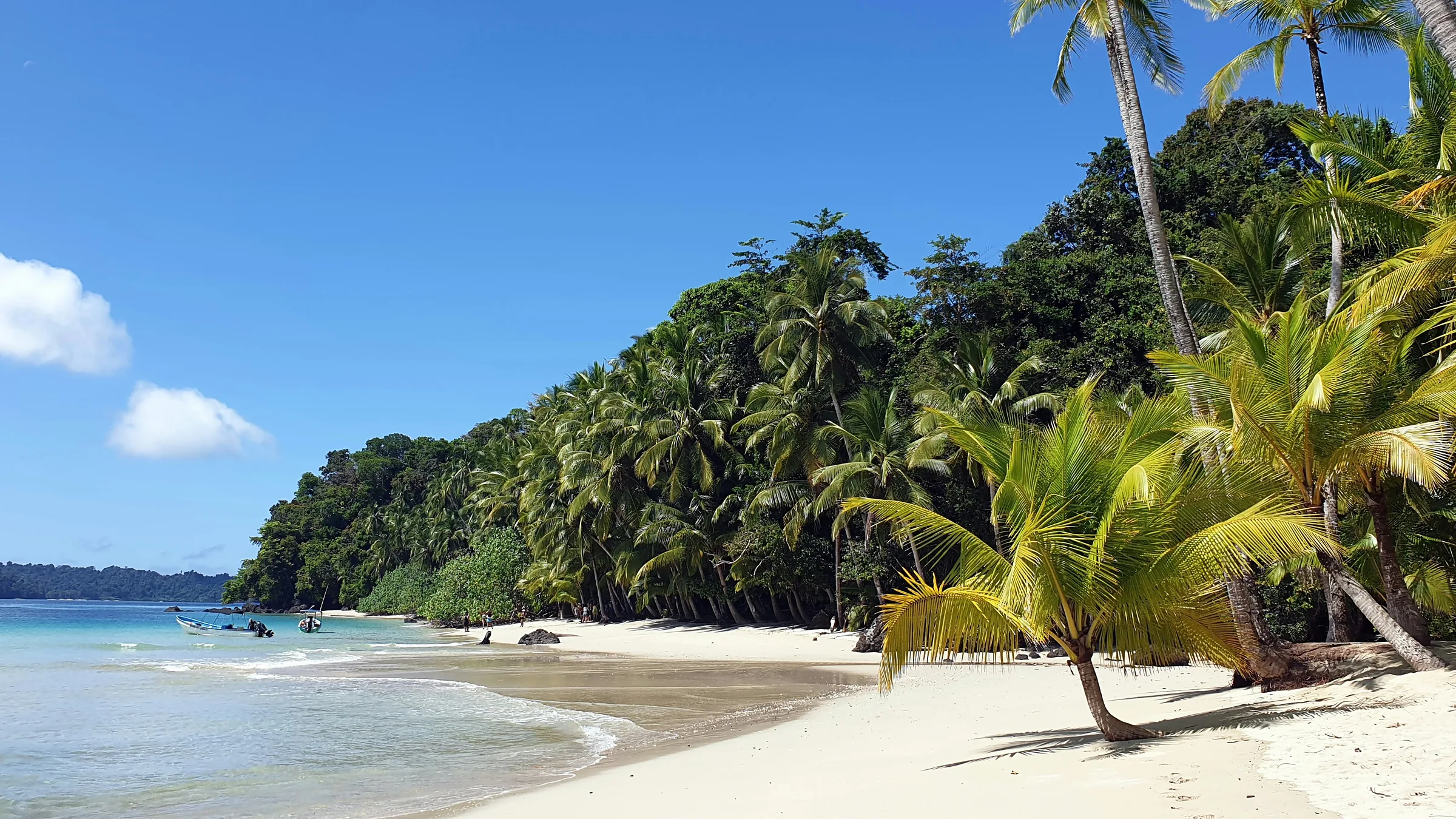
Light sandy beach with palms and vegetation beside the sea.

Panama · Veraguas province (Pacific)

Coiba
and Santa Catalina.

A Veraguas surf village and the gateway to a World Heritage marine park.

Photo: Chema Photo

Before you go,
understand the place.

Coiba National Park protects Coiba, the largest island in Central America, 38 other islands and the surrounding sea in the Gulf of Chiriquí. It has been a UNESCO World Heritage Site since 2005 and records 760 marine fish species, 33 shark species and 20 cetacean species. MiAmbiente has studied hawksbill turtles here for more than 12 years; they use Coiba as a feeding ground.

Best time to go
On the Pacific side the dry season runs from December to April and the rainy season from May to November, with September and October the wettest months and a drier 'veranillo' spell between July and August (IMHPA). The Government of Canada places the rainy season from April to December, and the UK names October and November as the months with the heaviest rain. The dry season brings the calmest seas for the Coiba crossing, according to the operator Snorkel Coiba (guide updated June 2026). Humpback whales: July to October (MiAmbiente, 2025); Visit Panamá gives July to September as peak months. Whale sharks: January to March (Visit Panamá). Surf: there are waves all year, but sources disagree on the biggest-swell months.
Getting there
By car: from Panama City, the Pan-American Highway reaches Santiago de Veraguas in about 4 hours; then take the La Peña turnoff toward Soná and Santa Catalina. Visit Panamá puts the whole trip at about 6 hours; a local operator says 5–6 hours. By bus: direct buses run from Albrook Terminal to Soná several times a day; alternatively, go to Santiago and catch a local bus to Soná there. Buses run from Soná to Santa Catalina (about 1.5 hours). Timetables published by hotels and operators disagree and no official timetable is published: the last bus from Soná to Santa Catalina leaves between 15:30 and 16:30 depending on the source, and some departures do not run on Sundays. One operator estimates 7–8 hours and about US$15 in total. Charter flights use nearby airstrips. Coiba is reached by boat with an operator: 1–1.5 hours from Santa Catalina. Pixvae and Puerto Mutis are other departure ports.

Six ways to explore

Themed guides

Places grouped by theme, to plan your day.

  • 6 places

    Snorkeling and diving in Coiba

    Snorkel and dive trips leave from Santa Catalina and take the whole day. The park fee is paid separately and Granito de Oro is closed.

    Open the full guide
  • 4 places

    Surfing in Santa Catalina

    A reef break for experienced surfers, a sandy beach to learn on and a point for experts, all close to the village.

    Open the full guide
  • 4 places

    Marine life by season

    Humpback whales from July to October, whale sharks from January to March and hammerheads mostly from April to July, according to official sources and operators.

    Open the full guide
  • 4 places

    What is closed or limited in 2026

    MiAmbiente is rebuilding the park headquarters over 24 months from April 2026. Meanwhile you cannot sleep on Coiba, Granito de Oro is closed and visits to the old prison are suspended from May 2026 for six months.

    Open the full guide
  • 4 places

    Departure ports for Coiba

    Santa Catalina has the widest choice of tours and lodging. Pixvae is the port closest to the park and Puerto Mutis the closest to Santiago.

    Open the full guide
  • 4 places

    A day without a boat in Santa Catalina

    For your arrival day or when the sea rules out Coiba: beaches, a surf lesson and kayaking near the village.

    Open the full guide

The place, in context

Everything you can do

Closed or restricted places are included and flagged, so you know what to expect.

Showing 18 of 18 · 4 closed or restricted, flagged

Nature and jungle · 5

Sea, beach and reef · 4

Lakes, rivers and waterfalls · 6

Living culture · 3

Coiba and Santa Catalina · Practical guide

The essentials

  1. Day snorkeling at Canal de Afuera, the Coco islets and Ranchería, with turtles and reef sharks.
  2. Diving in the park from Santa Catalina; hammerhead dives at the Contreras Islands for experienced divers.
  3. Humpback whales from July to October.
  4. Surfing at La Punta (advanced) and lessons at Playa El Estero.
  5. Kayaking to Isla Catalina off the village.

Coiba and Santa Catalina · Practical guide

Suggested itinerary

  1. Day 1Travel to Santa Catalina via the Pan-American Highway and Soná; if you go by bus, reach Soná early because the last bus to Santa Catalina leaves mid-afternoon. Pay the Coiba entry online (B/.20 for foreigners) and book your tour. At sunset, watch La Punta from the shore or take a lesson at Playa El Estero.
  2. Day 2Coiba day tour (about 8:00–16:00): stop at the Gambute station, snorkel at Canal de Afuera and the Coco islets, and beach time on Ranchería. Bring your passport and proof of payment. From July to October, look out for humpback whales on the crossing.
  3. Day 3Day of diving in the park (certification required) or a kayak trip to Isla Catalina and surfing at El Estero. In the afternoon, bus back to Soná or drive out in daylight.

Coiba and Santa Catalina · Practical guide

Where to stay

Santa Catalina village
The widest choice of lodging, restaurants, dive centers and surf schools. Almost all Coiba tours leave from here.
Playa El Estero
Area east of the village, along Vía El Estero, by the learning surf beach.
Pixvae
Small community and the port closest to the park. According to the operator The Ark Divers (undated page, checked October 2026), there was no electricity as of 2021, and there is no phone signal or ATM.
Coiba island
Overnight stays in the park are not allowed while the Gambute station is rebuilt (from April 2026, 24 months).

Coiba and Santa Catalina · Practical guide

Practical tips

  1. Before paying the Coiba entry fee, confirm with your operator who receives the money, by what means, what receipt proves your entry and whether it has already been arranged: MiAmbiente sells the entry online; Premier Coiba Tours says it is paid directly to the park, in cash before boarding, and Snorkel Coiba says it is paid in cash on arrival. If this does not match MiAmbiente's information, check with MiAmbiente. Always bring your ID (ID card or passport) and, if you pay online, the receipt. On the tours reviewed, the park fee is extra.
  2. Bring cash: according to the operator Premier Coiba Tours (page checked October 2026), Santa Catalina has only one ATM and frequent power cuts knock out card payments; Soná has ATMs and a bank.
  3. If a tour advertises Granito de Oro, ask what replaces it: the island is closed.
  4. Trips with a night on the island are not offered while overnight stays remain suspended during the Gambute works.
  5. Diving at the Contreras Islands requires an advanced certification and experience.
  6. If you travel by bus, leave Panama City early so you do not miss the last bus from Soná to Santa Catalina.

Safety and precautions

  • Panama's beaches are not usually supervised by lifeguards; tides cause strong currents and rip currents are common (Government of Canada, 2026). Ask locally before swimming.
  • Visit Panamá describes Punta Santa Catalina (La Punta) as a place with powerful tubes, and Punta Brava as another spot for experienced surfers, with good breaks and tubes. Playa El Estero has smaller waves and a sandy bottom; the source recommends it for beginners in summer (the dry season).
  • Choose established dive operators with insurance, and make sure your travel insurance covers diving (Government of Canada, 2026).
  • Canada lists Coiba island and the whole Pacific coast as drug-trafficking corridors, more dangerous at night. If you go out by boat, do so in daylight with an established operator.
  • The Pan-American Highway has frequent night roadworks and poor lighting (Government of Canada, 2026); plan to arrive in daylight.
  • Emergencies: 911 (SUME, medical care and coordination); Fire Brigade 103; National Police 104.

Frequently asked questions

How much is the Coiba entry fee?

In MiAmbiente's payment system (2026): B/.20 foreign adult, B/.5 Panamanian adult, B/.10 foreign student, B/.3 Panamanian student and B/.2.50 seniors; under-12s free. The boat tour is paid separately: US$70–90 for snorkeling or US$140–165 for diving (Snorkel Coiba, Unlimited Adventures and Premier Coiba Tours; Scuba Coiba and Panama Dive Center; pages checked October 2026).

Can I stay overnight on Coiba?

Not in 2026. MiAmbiente suspended overnight stays while it rebuilds the Gambute station, under construction since 3 April 2026 with a 24-month timeline. Operators only offer day trips.

Is Granito de Oro open?

No. MiAmbiente keeps the island fully closed so its reefs can recover and has not announced a reopening. Tours use other snorkel stops.

Can I visit Coiba on my own?

According to the operator Snorkel Coiba (guide updated June 2026), visitors arrive with a licensed boat operator and independent boats are not permitted for tourists. MiAmbiente's 2022 notice requires each maritime transport operator to register passengers and vessel, and every vessel to report first to the Gambute headquarters, but it does not expressly ban or authorize independent access. If you plan to go on your own, check with MiAmbiente first.

When can I see whales?

July to October, when humpbacks arrive from the South Pacific (MiAmbiente, 2025). Visit Panamá gives July to September as peak months.

Can I visit the old prison?

Not for now: visits are suspended from 1 May 2026 for six months. Its reopening is not confirmed by the official source at the time of review.

Does the transfer of inmates to Coiba affect tourists?

Since June 2026, 29 inmates have been held at the Senan air-naval station on the island. MiAmbiente said no activity takes place outside that facility, and no restrictions on day visits were announced. Local tourism chambers oppose the measure.

Coiba and Santa Catalina · Practical guide

Sources consulted

Information checked in . Prices, hours and rules change: confirm them with the official source before you travel.

  1. Sistema de Reserva de Áreas Protegidas – MiAmbiente2026
  2. MiAmbiente inicia obras de rehabilitación en el Parque Nacional Coiba y limita acceso a visitantes – TVN2026
  3. Coiba fortalece la protección de la tortuga carey – MiAmbiente2026
  4. MiAMBIENTE ejecuta obras para la nueva sede y muelle en el Parque Nacional Coiba2025
  5. MiAmbiente implementa pago en línea para áreas protegidas – Panamá América2024
  6. Se restablece capacidad de carga del Parque Nacional Coiba – MiAmbiente2022
  7. Ministerio de Ambiente avala traslado de 29 reos a Isla Coiba – Infobae2026
  8. Presencia de reos en Isla Coiba compromete economía local y turismo – La Estrella de Panamá2026
  9. Coiba National Park – Visit Panamá (ATP)2026
  10. Santa Catalina – Visit Panamá (ATP)2026
  11. Whale Watching in Panama – Visit Panamá (ATP)2026
  12. Nautical Itinerary: 9 Days Along the Pacific Coast – Visit Panamá (ATP)2026
  13. Panamá da la bienvenida a la temporada de ballenas jorobadas – CB242025
  14. Régimen pluviométrico de Panamá – IMHPA2026
  15. Panama travel advice – Government of Canada2026
  16. Panama travel advice – UK FCDO2025
  17. Coiba National Park and its Special Zone of Marine Protection – Natural World Heritage Sites2019
  18. Bus directions – Catalina's Hideaway2026
  19. Travel Information – Premier Coiba Tours2026
  20. Dive Trips with Scuba Coiba (operador)2026
  21. Snorkel Coiba (operador)2026
  22. SUME 9112026
  23. Benemérito Cuerpo de Bomberos de Panamá2025
  24. Policía Nacional de Panamá2026
  25. Ultimate Guide to Visiting Coiba National Park – Snorkel Coiba2026
  26. About Pixvae – The Ark Divers (operador)2026
  27. Full Day Coiba from Santa Catalina – Unlimited Adventures Coiba2022
  28. Coiba Day Trip – Premier Coiba Tours2020

Other destinations